
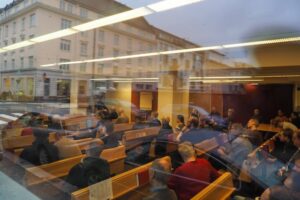
The Diocesan Assembly of the Mission Diocese was held on Saturday 14 November at the Koinonia Centre and via remote connection. Photo: Janne Koskela
The highest decision-making body of the Evangelical Lutheran Mission Diocese of Finland, the Diocesan Assembly, convened for its annual meeting on Saturday 14 November. A total of 118 participants were registered; around half of them attended in person at the Koinonia Centre in Helsinki, whilst the rest took part remotely. The number of participants was an all-time record, reflecting the growth in the number of parishes over the past year. Every organised congregation has the right to send its representatives to the meeting.
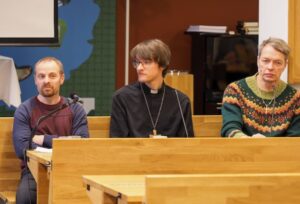
Panel members: Petteri Suontama, Mikko Aho and Markku Forma. Photo: Janne Koskela
In the morning, before the business session, discussion was held on the topic of doubling the number of congregations. Bishop Juhana Pohjola opened the session, introducing the topic. This was followed by a panel discussion, chaired by Community-Building Coordinator Lilli Lanki, in which representatives from three congregations discussed the doubling process: in Pastor Mikko Aho’s congregation in Turku, plans for doubling have been discussed from time to time. Markku Forma is a member of St James’ congregation in Kangasala, which was established as a result of a doubling process from St John’s in Tampere. Petteri Suontama recalled how the doubling process was carried out around ten years ago, when the Espoo congregation was established from St Mark’s in Helsinki.
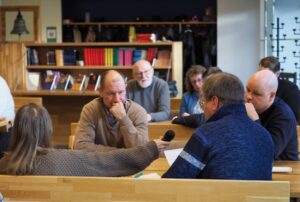
The panel discussion highlighted a variety of perspectives on the doubling of congregations. Photo: Janne Koskela
Following the panel discussion, in small groups we discussed the ideas raised by the concept of doubling. Many important perspectives emerged. First and foremost, this is a matter of mission work, a process which must take into account both those moving to the new congregation and those remaining in the original one. When the time comes for the doubling, parishes must consider, amongst other things, finances, the pastor’s possibilities for serving, and then finding people to take on leadership and service roles. Despite all the potential challenges, Lilli Ranki encouraged the participants, assuring them that the Lord would certainly guide the work. After the discussion, it was time for a delicious salmon lunch – and we all send a warm thank you to the whole kitchen team for the day’s refreshments!
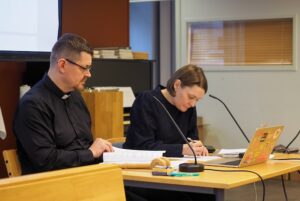
The Diocesan Assembly was chaired by the Rev Pekka Puustinen, MD. Pauliina Pylvänäinen served as secretary. Photo: Janne Koskela
As is the case every year, the Diocesan Assembly discussed, amongst other things, last year’s annual report and financial statements, as well as the plan for activities and the budget for 2027. This year, the Assembly also decided on amendments to the Diocesan Regulations. The previous Diocesan Regulations had been approved at the 2021 Diocesan Assembly; since then, the Church has grown, practices have evolved, and consequently the Diocesan Regulations needed updating in certain respects.
The Constitutional Committee, which had been working on the matter, had drawn up a proposal for new diocesan regulations. Prior to the Diocesan Assembly, the proposal had been discussed at the pastoral conference days, at two meetings of the Diocesan Council, at parish council meetings, and at a remote meeting of Diocesan Assembly delegates.
One of the most significant changes, in principle, was the clarification of the role of the Finnish Luther Foundation within the Mission Diocese’s activities. This had not been addressed in previous diocesan regulations, but the Constitutional Committee that drafted the proposal now considered the addition necessary.
“The aim here has been, above all, to increase transparency. A single document now better illustrates how the Mission Diocese functions as a whole and what its relationship is with the Finnish Luther Foundation,” commented Diocesan Dean Joel Kerosuo.
There was particular debate regarding the proposed change to the composition of the Diocesan Assembly. The committee had proposed limiting the number of participants so that, in future, each parish would be represented at the Assembly by one layperson (instead of two) and one member of the clergy. Following a lively debate and a vote, the proposal remained in force. Afterwards, Bishop Juhana Pohjola commented on the decision as follows:
“It is good that we can discuss, disagree and vote on issues on which it is possible and permissible to hold differing, well-founded views. This is a sign of open and healthy ecclesiastical decision-making. I hope that those who departed the Koinonia Centre into the dark November evening were not divided into winners and losers, but rather into representatives who were able to express their views on behalf of their congregations, views which were collectively weighed up in the vote.”
Pohjola also wished to emphasise the view previously put forward by the Constitutional Committee, namely that the Diocesan Assembly of the Mission Diocese has never been a matter of confrontation between the clergy and the laity, but rather that pastors and laypeople together represent their own congregations.
“The diocese consists of parishes, and the parishes, in turn, consist of shepherds and their flock. At Koinonia, there were no separate benches for clergy and laity, nor are there separate sections for men and women in the sanctuary. Clergy and laity together represent their congregation, praying for the common good of our church!”
Pohjola also pointed out that the concern raised in the discussion regarding the relative increase in the number of clergy naturally differs from the current situation in the General Synod of the Evangelical Lutheran Church of Finland, the national Church. However, internationally, when compared with the Sister Churches of the Mission Diocese, we are on a par:
“If we look at our sister churches, the breakdown is as follows: in Germany, within the SELK, clergy account for 51 per cent and laypeople 49 per cent; in the United States, within the LCMS, and in Canada, within the LCC, the corresponding ratio is 50/50 per cent.”
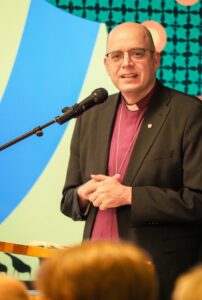
Bishop Juhana Pohjola was authorised to sign agreements with three new Sister Churches. Photo: Janne Koskela
Finally, we were able to celebrate the establishment of ecclesiastical fellowship with no fewer than three Churches. The Diocesan Assembly authorised Bishop Juhana Pohjola to sign agreements recognising ecclesiastical fellowship with the Confessional Lutheran Church in Australia, the Evangelical Lutheran Church in France and the Lutheran Church of Istanbul.
The Australian Confessional Lutheran Church (Lutheran Mission – Australia) was founded in the spring of 2026. This followed a decision by the country’s larger Lutheran Church body to change its understanding of the office of ministry. The Church comprises 25 parishes, located mainly in the southern states and in north-eastern Queensland.
The French Evangelical Lutheran Church (Église Évangélique Luthérienne – Synode de France) is a key actor, particularly amongst French-speaking Lutherans and in French-speaking mission fields. The Church’s roots lie in the 19th-century German Lutheran revival. The Church has ten congregations, the majority of which are located in the former German-speaking region of Alsace.
The Lutheran Church of Istanbul (İstanbul Luteryen Kilisesi, ILK) was established in its present form in 2003, but its historical roots stretch back over 300 years. The church is formed of five congregations located in Turkey and Bulgaria.
Upon the unanimous confirmation of these, the Assembly rose to give thanks and praise to God for our new Sister Churches, singing the hymn “Give Thanks to the Good Lord”.
English translation: Tom Toepfer
