Summer Festival Grows and Advances
18.8.2026

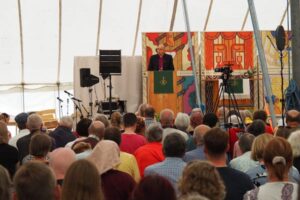
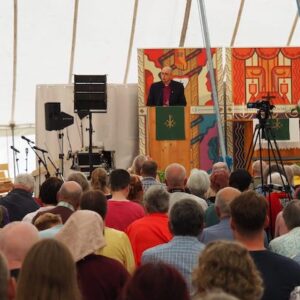
The blog is a speech delivered by Bishop Juhana Pohjola at the Evangelical Lutheran Mission Diocese of Finland Summer Festival on 2 August 2025. Photo: Juho Pylvänäinen
There they were listening, the young and old alike. Their journey together had already spanned four decades. The promise of the inheritance was proclaimed to the vast crowd: “Go in and take possession of the land that the Lord swore to your fathers, to Abraham, to Isaac, and to Jacob, to give to them and to their offspring after them.” (Deut 1:8) Thus, on the plains of Moab, Moses preached for the last time to the people who had left Egypt and were preparing to cross the Jordan River into the Promised Land. How did Moses encourage those who were afraid to move toward an unknown future? Where did they find the courage to embrace an inheritance that held exciting possibilities but also seemingly insurmountable trials? “Do not be in dread or afraid of them,” (Deut 1:29) Moses begins. Fear discourages and paralyzes. It takes away joy and the willingness to try. But, Moses, how can we not be afraid when we are truly terrified? The servant of God continues: “The Lord your God who goes before you will himself fight for you, just as he did for you in Egypt before your eyes, and in the wilderness… .” (Deut 1:30) The Lord was not going to stay on the plains of Moab, but was going to accompany them, go before them, and fight for them. If the battle belonged to the Lord, so did the fear. The Israelites not only heard the promise of what was to come, but they also had the personal testimony of God’s mercy and power from years past. Moses reminds them: “… you have seen how the Lord your God carried you, as a man carries his son, all the way that you went until you came to this place.” (Deut 1:31) The Lord goes before you and fights for you. The Lord carries you like a man carries a little boy the whole way in his strong arms!
Could this be an image for us as we look back on the past and forward to the future as a Church? Next week, on 6 August 2025, it will be twenty-five years since we set out on our journey, when our divine services began in Helsinki at the Ruoholahti Parish Hall before moving to the Mellunmäki Parish Center. Rev. Simo Kiviranta installed me to shepherd a flock of a few dozen people with the words: “For whoever has despised the day of small things shall rejoice…” (Zech 4:10). As a sign of the passing of time, the Mellunmäki Parish Center has been demolished to make way for an apartment building, and the Ruoholahti Parish Hall now serves as the Azerbaijani Cultural Center, but that one worship community has grown into an independent Lutheran Church in Finland.
What has this shared journey entailed? A fear of taking new steps and a reluctance to trust in God’s possibilities. Ecclesiastical struggles for the right to gather for Mass and receive the Eucharist. A battle in the courts against criminal charges. The weariness of being a minority and bearing the stigma of opposition. Steps into the unknown as small groups of people took on responsibility and organized themselves into congregations, and the congregations organized themselves into a Lutheran Church. Concerns about filling duty lists for various responsibilities, finding suitable facilities, covering expenses, reaching new people… . No matter how difficult it has been, can you still say with me, with your hand over your heart, with gratitude: The Lord has gone before us, fought for us Himself. God has carried us, just as a man carries his son the whole way! Now you understand why the Christians of old repeated the phrase: the one being carried grows weary, but the one doing the carrying does not! The Lord does not grow weary, tired, or ever give up on carrying you and all of us!
Today, we are not on the plains of Moab, but on the open fields of Loimaa, asking what else the Lord has in store for us, the heirs of the same promise. At our first summer festival in 2019, we tentatively envisioned where the Evangelical Lutheran Mission Diocese of Finland would be in 2025. At that time, we prayed for 25 new congregations, 25 new pastors, and 2,500 new members. Coronavirus came and went, but despite the difficult years, 15 new altars and pulpits have been erected, and five sister congregations have been added from the Lutheran League of Congregations (Seurakuntaliitto). Seventeen new pastors have been ordained, including tomorrow’s pastoral candidates, five were ordained elsewhere who have joined the pastoral collegium, and four brothers, pastors, from the Lutheran League of Congregations. That makes a total of 26! The number of our congregation membership has grown by over 800, and together with our sisters and brothers in the Lutheran League of Congregations, we have gained over 1,200 new family members. We are not here to crunch statistics or boast about growth figures, but to gratefully acknowledge that the Lord has gone before us and carried us! But one perspective is often forgotten: those who have reached their final destination among us. Thank you, Heavenly Father, for calling them. Let us also follow in the footsteps of the blessed.
As we look ahead to the 2030s, I would like to highlight three perspectives on our society, the ecclesiastical domain, and the outlook for our Church.
Moses repeats to the new generation the Law and the Ten Commandments given by God on Mount Sinai. The first three commandments concern our relationship with God. They are followed by commandments concerning temporal life: “Honor your father and your mother, that your days may be long in the land that the Lord your God is giving you. You shall not murder. You shall not commit adultery.” There is much that could be said about the commandments, but I would like to draw your attention to two points. God reveals how he has planned and arranged the beginning and end of human life. First, we hear how life begins: “Honor your father and your mother.” You, me, all human beings have a father and mother according to God’s order of creation. This threefold bond between father, mother, and child is a precious and holy order established by God. For the protection of marriage and family and for the best interests of children, the Lord gives the sixth commandment: “You shall not commit adultery.” After God commands us to protect the order of life’s creation, He immediately follows with the command to protect the end of life in the 5th commandment: “You shall not murder.” God, the giver of life, reserves for Himself and Himself alone the right to end life.
I was in Turkey in the spring as a guest of a Lutheran congregation. The windows of the apartment building where the congregation gathered opened across the street to where there was an old church building from the Byzantine era. All Christian elements had been removed from it, and it had been converted for cultural use. That space had been desacralized, stripped of its sacred use, even desecrated.
According to Prof. Carl F. Trueman, our culture has undergone a desacralization of our worldview, a stripping away of the sacred. The supernatural mystery of life and its divine foundation have been pushed away to the margins. The world no longer recognizes the built-in sacred order, the divine plan, or the invisible reality that transcends our reason and senses. Two things in particular have undergone not only desacralization but desecration: sexuality, i.e., the mystery of the origin of life, and the mystery of death.
In the past, the beginning and end of human life were lived communally, with dignity and ritual, before God. Marriage was sanctified and the bridal bed was blessed. After the birth of a child, first through circumcision and later through Holy Baptism, the child was incorporated into God’s promises. The dying were prepared communally with prayer and the Word of God, their bodies were then washed, blessed, and laid to rest in graves, in holy ground, or under the floor of a church, as in St. Mary’s Church in Turku (southwestern Finland), where some 200 coffins were excavated from inside the church this summer.
The background of the sanctification of life and death was the value and significance that God gives to our physicality. It is precisely the loss and desecration of the value of our bodies and physicality that lies at the heart of the darkness of our culture. In the words of one researcher, according to the modern view of humanity, we are “flesh Legos” that can be used and combined, clicked together, according to our own desires. In the name of individual freedom, we can detach our bodies into countless different casual relationships with our own or the opposite sex, through reproductive technology separate parenthood from a biological father and mother, cut off parts of our bodies according to our gender experience, or sink into a virtual world of lust without any physical reality. Sexuality as a gift from God has been separated from marriage, from the beauty and sacrality of becoming one flesh, the fruit of which God can create a new body and soul for a child of the womb.
What about the other end of the spectrum? Our culture of death thus reflects the desecration of the temple of the body. Human life and bodily integrity are not inviolable and sacred. The human mind has taken control of the body, and the human will has taken control of God’s order. Death is not the only limit set and determined by God. According to Finnish law, the mother decides on the life and death of every child she carries in her womb. Those intoxicated by individual freedom want the right to decide when to die–through euthanasia. The glorification of a culture of violence lowers the threshold for violating another person’s physical integrity and leads to abuse. Transhumanism seeks to use technological advances to shift and even erase the boundary of death. Perhaps in the future, people will no longer visit graves, because after a celebration of life and the ashes being composted, they will be able to interact with a digitalized version of their deceased loved one created by artificial intelligence. Somewhere in the realm of the new spirituality we are guided to seek paths behind the veil of death into the spirit world. Amidst the pressures of appearance, our trimmed and rejuvenated bodies are, on this value basis, nothing more than a mass of cells that overloads the ecosystem.
I am not stating all this because summer festival speeches should lament the decline of our times, but because we are faced with human suffering right before our eyes and in our midst. If the human body has only instrumental value, what will become of the human person? We are spiritual-mental-physical entities. The obvious consequence of violating God’s holy order, dishonoring physicality, and losing sight of our eternal destination is something we are already seeing. A feeling of meaninglessness in life, a reality of purposelessness and emptiness. A lack of perspective that shakes our very existence. According to studies, this is exactly what young people experience. How can a ”flesh-Lego” find a foundation and direction for its life that transcends the satisfaction of its desires? Can competing with one’s own material and experiential Legoland afford meaning to life?
The pastor of the Turkish congregation told us how, before the start of every service, he opens the window and looks at the desecrated and defiled church building and prays that one day the congregation will be able to gather there in the name of the Triune God. When we look out of the window of our culture and see young and old people who have lost the value of physicality and the purpose of life, could we have the same prayer? Could human beings be resacralized, that is, given value as images of God and eternal beings? Moses cried out to the people: “…I have set before you life and death, blessing and curse. Therefore choose life… .” (Deut 30:19). As malaise and hopelessness grow, the search for meaning in life increases. This now is a glimpse of hope! We carry with us the Word of life. Why must we walk the path of curses when the path of life is open! Christ’s pierced hand is behind everything. God is truth, goodness, and beauty. Life has a sacred order and purpose. He has a plan for your life. In the church, we do not use God’s commandments to shame people or put them down, but to lift them up, love them, and care for them with the mercy of God. Let us see and meet people, wandering and wounded people, not just out there, but here among us! You are a miracle, a great miracle, and I thank God for you! The forgiveness of sins is real for you! Your life has a purpose beyond the thirsts and cravings of life: we believe in the resurrection of the body. Christ has the keys to life and death!
We carry out this calling as a minority, just as Moses did and the early Christians did. According to a study published last year by the Finnish Church Research Institute (Evangelical Lutheran Church of Finland), Finland has reached a cultural turning point where Christian faith and active participation in congregational life are considered unusual. Although the majority of the population still belongs to this national church, adherents of classical Christianity are a small minority in our country. Another perspective on this is the ongoing spiritual battle and the waves of ecclesiastical change.
”Take to heart all the words by which I am warning you today, that you may command them to your children, that they may be careful to do all the words of this law. For it is no empty word for you, but your very life….” (Deut 32:46)
Moses not only gave God’s living words to the people, but also obliged them to pass on these words to new generations, right up to us today. It would be a lack of historical awareness and spiritual hubris to emphasize only the short history of our Church. We received the Words of faith from our fathers and mothers long before the Finnish Luther Foundation and the Evangelical Lutheran Mission Diocese were formed. We are grateful to the Evangelical Lutheran Church of Finland and the revival movements that have influenced it for their legacy of faith, liturgy, hymns, spiritual literature, and church life. Of course, many people have found their way to our congregations on completely different pathways.
As we approach the 2030s, the ecclesiastical domain is undergoing a transformation. To our sorrow, despite its many faithful workers and good diaconal programs, the national Church, the Evangelical Lutheran Church of Finland has chosen a direction that continues to lead away from the Word of God. This is apostasy and lawlessness under the Lutheran name. There is no ambiguity about this, and there is no need to elaborate further. Nor is there any ambiguity about the fact that we stand independently as a separate Church. I certainly hope that our Church can have proper ecumenical relations with the Evangelical Lutheran Church of Finland.
Several revival movements that have gathered under the tent of the national Church within this ecclesiastical domain are facing the spiritual and theological decline of the national Church. This then results in a shrinking living space for them. This has led both to closer mutual communication between these movements and to the purposeful building up of worship communities. Questions about cuts in funding for mission projects, pastoral ordinations, permission to celebrate communion, and baptisms for those who have left the national Church are fueling discussion about these movements perhaps creating their own church structure, even though outwardly the message being delivered is that these inner-church revival movements want to remain within the national Church. One major change is their new policy of continuing to hold divine services without the permission of the diocesan chapters. What will come of this remains to be seen!
What does this mean for the Evangelical Lutheran Mission Diocese? First of all, in recent church history the Mission Diocese was born around a gathering of revival laity and pastors. When I look out over my audience, the congregation and the clergy, some of you have an Evangelical Revival Movement background, while others have a background in the Praying Pietist Revival Movement. Some of you have had grace revealed to you through the work of the Finnish Lutheran Mission revival movement and others the Finnish Bible Institute revival movment. How many of you have roots in the Laestadian revival Movement, and some in the Awakened revival Movement? [Some of these movements are well over a hundred years old, others much more recent.] The richness of the revival movements in Finland is alive not only in organizations but also here, in our homes, and even in Lutheran hymns. How many of us are influenced by these connections through family ties? This is a blessing for us. At the same time, we should rejoice that many present today have not heard much about these movements at all. Even better, if someone here asks what is this Mission Diocese, that would be satisfying! From different starting points, the Holy Spirit has brought us together as Lutheran congregations. The Bible speaks of congregations, and it is in them that the Church lives locally!
Secondly, our existence may encourage organizations struggling for recognition. We have already faced the same issues about pastoral ordination and the right to administer communion. What a loss it would have been if we had stopped our work at the behest of the diocesan chapters and had not exercised the freedom outlined in the Book of Concord to live fully from the gifts of Christ. I now see that our expulsion from the national Church was a hidden gift of God’s protection for us—and I firmly believe this for others who are facing the same situation. For the spirit of deception is strong. Many of the fears associated with ending up outside the national Church relate to the danger of internal division and turning inwards, as well as link to dwindling opportunities to reach people. Of course, these dangers loom over us, but could our 25-year journey prove that they are not predetermined? Despite all its shortcomings, the confessional church can walk in the Word and in harmony, inviting new people to join as well as forging connections at home and abroad.
Thirdly, we want to pray for those revival organizations that do work for the Word of God and the Lutheran Confessions and pay the price for it within the national Church. Many organizations want to be both movements recognized and supported by the national Church and independent actors with their own congregations. This is a difficult equation, which has sometimes led to compromises that are difficult to justify. The relationship with the national Church is a divisive issue even within the organizations themselves. An additional difficulty is the historical fact that the organizations were not established as church structures. Each organization must follow its own path, as we did. However, the tectonic plates are shifting. In my view, younger members of revival movements in particular are voting with their feet. The theological decisions of the national Church are not only seen as wrong, but also as a reason to leave. The national Church is becoming irrelevant and emotional ties are eroding. A new home has been found in worship communities. This increases the pressure within the movements towards greater independence.
Fourthly, in the Evangelical Lutheran Mission Diocese, we want to build connections with organizations that are caught up in the jaws of, the tight grip of, change. There is no need to look for excuses for stirring up disagreements, but rather to seek to build connections. From our point of view, the big question is what kind of future we are talking about. If the future framework for these revival movements is to remain within the national Church, then communication is important, but it would be difficult to expect anything more than that. If, on the other hand, the framework for the future is: divine service / worship communities with ordained pastors, then there is much to be found in common. We are all on a journey and much is open, but the direction is decisive. Do we not all acknowledge that Christians need a living congregation based on the whole Word of God, congregations need a Church, and local Churches need other sister Churches?
As we look toward the 2030s, at least two perspectives emerge. The first perspective is “S” for SCATTERING: Many have somehow adapted or found a safe cubbyhole somewhere within the spiritual delusion of the national Church. A large number of Christians who have left the national church live without any parish or church membership. There are a number of theologians who have not been ordained, shepherds without a leading shepherd, a bishop, and worship communities without a supra-congregational church structure. Or new Lutheran churches have been formed without any mutual connection between them. “When he saw the crowds, he had compassion for them, because they were harassed and helpless, like sheep without a shepherd.” (Matt 9:36)
Another perspective is “G” for GATHERING: Calling upon the Holy Spirit for help, answers have been sought and found to the question of how shepherds and flocks can together build biblical, confessional, focused on the divine service, communal, self-supporting, and evangelical / evangelizing congregations for future generations in the post-Christian mission situation of the 2030s. A way has been found to walk together in the same Church or in different Churches that are nevertheless connected by altar and pulpit fellowship. “I will gather the remnant of my flock… I will bring them back to their fold.” (Jer 23:3)
The primary, common question then is: How can we build congregations and a Church in the 2030s that are in line with the seven marks of the Lutheran Church? We do not need to simply dream about this future, but rather we need to patiently discuss and pray together to find a common basis of confession, with its corresponding church practices, and then mutual trust. In our prayers we have the desire and readiness to so do!
What does the future hold for the Mission Diocese as we move towards 2030? We have a solid foundation in the gospel of grace and a sustainable vision for the mass / divine service for life and for the congregation as a home. We have the freedom to act and the strength of service-minded congregational members and committed supporters. The new generation is taking on responsibility in a wonderful way also here at this summer festival. We are still being given young men with the calling of shepherds. There are new congregations starting up. Our economy is on a stable footing. All the conditions are therefore in place to continue our fruitful work under God’s protective hand.
If we squint at the figures and project those into the future, then in light of previous developments, we would have over 60 congregations in 2030, just under 4,000 congregation members, and around 90 in the clergy. Only the Lord knows! Let us not get hung up on the figures. We want to work calmly and purposefully so that as many people as possible can come to know the rich inheritance of Christ’s mercy and to experience care in the congregation. In some congregations, however, the question may arise as to whether there will still be the resources to maintain a congregation. More important than growth is to keep our confessional foundation and our vision clear and to continue to develop a communal culture in which congregations learn together to speak, live, serve, and even double in size as congregations if the number of people grows.
I dare say that the Mission Diocese is the best-kept secret in Finnish Christianity!
There are signs of spiritual inquiry and a search for a place to call home in our time. When visiting different congregations, many newcomers have told me that they had never heard of us before noticing us in the media. I dare say that the Mission Diocese is the best-kept secret in Finnish Christianity! Finland’s second largest Lutheran church is the best kept secret! There are certainly many reasons for this, such as our short history as a church and our limited resources, as well as the culture of silence that surrounds us. There is certainly room for improvement, for example in our media work and online communications, but ultimately, the patient work of the congregations will ensure that the city on the hill cannot remain hidden. So, I dare to hope that in 2030, the Mission Diocese would be well enough recognized that we could either be opposed or promoted, but it would be more difficult for the surrounding society to ignore us simply due to of a lack of information about us or because of a veil of silence was thrown up around us.
Where is the Missionary Society’s vision of world mission? I am often asked this question. My answer is: we live in a mission field in Finland, but world mission is also part of the life of our Church. The request Paul recieved, ”Come over and help us,” echoes ever louder in our ears. As members of the International Lutheran Council, we have a global network, and there is a crying need for missionaries to do teaching work. In addition to short teaching trips, three of our pastors have been called to serve our sister churches abroad in Kenya, the United States, and Sweden over the past year, and a fourth has been involved in church construction work in Italy in addition to his doctoral studies. This is not a loss for us, but this is for the common good of God’s kingdom. We are currently in discussions about sending another pastor and family to work in Kenya. These requests and opportunities are only increasing. Here in Finland, I have heard from many people that mission work is declining outside the Finnish national church. We have never received any mission funds from the Finnish national church, but now the Lord is pouring on us as it were “rivers” of offers requesting cooperation with our sister churches, more than we can respond to. The Lord’s stream of missions is full of water! We do not live by dried-up brooklets! God has the means to show us our place in His world mission. May He give us the skill and talent to uphold our basic tasks in Finland and at the same time joyfully be at His service in foreign mission fields!
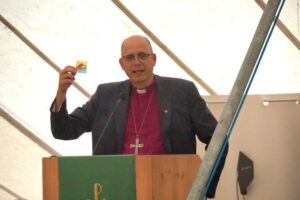
Juhana Pohjola and his “unfortunate Super Mario” train ticket. Foto: Juho Pylvänäinen
Two years ago, I was invited by our Parikkala congregation to their summer festival. This festival in Parikkala was to be held in one member’s home–within the eastern border zone, very, very near Russia. I left my home in Kirkkonummi (southern Finland, near Helsinki), by train, in high spirits, heading for this member’s home, so I was going northeast, mostly east. I changed trains in Pasila (Helsinki) and found my seat in a crowded carriage. My heart leapt into my throat after the Tikkurila station when I heard the announcement: Next stop, Tampere! North, not northeast! Now, I have nothing against Tampere (south central Finland), but I was on my way to Parikkala via Lahti. I had managed to get on the wrong train. A cold sweat broke out. I searched for the conductor and asked what I could do. After thinking for a moment, he promised the train would make an extra stop at the Riihimäki station, from where I could take a local train to Lahti and then get the train to Parikkala. Let’s give a shout out to the Finnish Railways! for their good service! Then, I sheepishly stepped out alone at the Riihimäki station. My electronic mobile ticket was now useless, but I had asked the conductor for a receipt. When I finally sat down on the Parikkala train in Lahti, several hours late, the conductor came to ask for my ticket. I handed him the receipt I had been given. He looked at it silently. It read ”children’s ticket” and had a picture of Super Mario on it. He looked at me and my purple bishop’s shirt and the children’s play ticket with the drawing of Super Mario–for a moment. He was silent, even incredulous. Then he noticed what was written on the back of the Super Mario ticket: “Passenger boarded wrong train. Should be IC 3. BR: Cond. #143.” And then with this children’s ticket, I traveled all the way to my destination in Super Mario class!
Moses proclaimed in the plains of Moab: “For this commandment that I command you today is not too hard for you, neither is it far off. It is not in heaven, that you should say, ‘Who will ascend to heaven for us and bring it to us, that we may hear it and do it?’ … But the word is very near you. It is in your mouth and in your heart, so that you can do it.” (Deut 30: 11-14) The word was good, right, and close by, but the people could not fulfill it because of human corruption. Moses did not lead the people to their destination but remained behind and gazed over the Promised Land. Joshua, that is Jesus, led the people to their destination. In time, the new Moses prophesied by Moses arrived, He in whom the Word became close, flesh, body, blood, mercy, and life among us, and a sacrifice for us on the cross. Christ Jesus sent his Apostles. Paul refers to Moses’ words: “The word is near you, in your mouth and in your heart” and then Paul adds: “that is, the word of faith that we proclaim; because, if you confess with your mouth that Jesus is Lord and believe in your heart that God raised him from the dead, you will be saved. For with the heart one believes and is justified, and with the mouth one confesses and is saved.” (Rom 10:8-10) Proclaiming the word for repentance and faith, confessing Christ as Lord at baptism, the washing of baptism for the forgiveness of sins, possessing the gift of salvation, and living in fellowship with the congregation! This is the meaning and purpose of life! Over this Jordan River, or baptismal water, Jesus carries His people, who are assured of His grace, to possess their inheritance.
What do we ask for today, then in 2030, and even beyond, in the Mission Diocese? That, baptized as children of God, we may, relying on the mercy of Christ’s blood, journey to our destination. If not traveling as Super Marios, then as the Good Shepherd’s lambs! Let the journey be winding and difficult, as long as you, Father, carry us all the way home!
Finally, I would like to share an excerpt from my first sermon at the Ruoholahti Parish Hall on Transfiguration Sunday, the 6th of August 2000. It was in this spirit and with this vision that the work began: “Although it seems almost depressing to think that the divine services that begin here on the ground floor of a small apartment building could in any visible way bring blessings, through faith we understand that God’s glory shines not in us, but in the Word and in the Body and Blood of Christ shared here. Today, it is proclaimed to all of us and to the whole city that because of Christ’s victorious sacrifice, we have the forgiveness of sins and thus access to God the Father! For this reason and this reason alone, we have the confidence, joy, and courage to live and serve together in the work of God’s kingdom.”
Dear sisters and brothers, this is how we want to continue to believe and preach, live and serve, joyfully in the work of His kingdom today and in the decades to come!
May the Lord grant us His help and the grace to do so!
English translation: Thomas Toepfer